
REVIEW · CHINA
Chongqing: Active Wellness, Monorail, and Hidden Gems Tour
Chongqing’s famous train-through-a-building sight is only one piece of this unusual day. You’ll pair Liziba Monorail Station with cliff paths, an old residential district, creative factory halls, and a Chinese garden that gives you a calmer view of this fast-moving mountain city.
I like the mix of active wellness and local food, and I like that the tour uses public transport or a chartered car rather than keeping you inside a tour bus all day. The main concern is stamina: eight hours of walking, stairs, hills, and transfers makes this a poor fit for wheelchair users or anyone with serious mobility limits.
- See the monorail enter an apartment building from Liziba’s viewing platform.
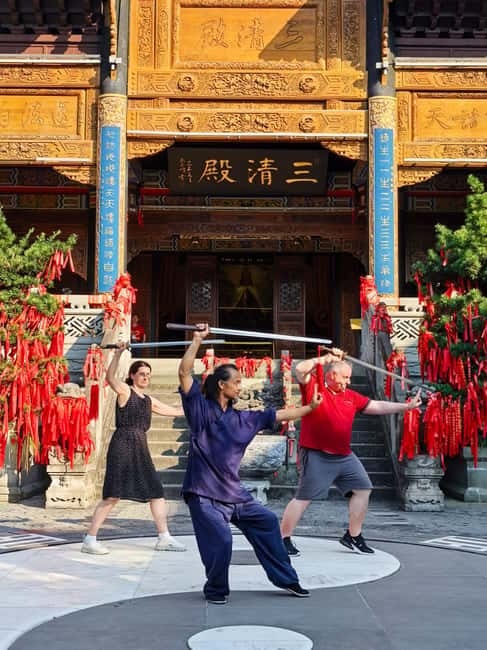
- Learn Baduanjin and Tai Chi with national master and ICH inheritor Tian.
- Walk a cliffside path above Chongqing’s stacked city streets and river valleys.
- Compare Chinese and Western garden design inside a large local garden.
- Taste fresh tea and simple local food while exploring everyday Chongqing.
- Travel privately with a guide in English, French, Italian, Spanish, or Traditional Chinese.
A full day of Chongqing beyond the postcard view
This private tour costs $166 per person and lasts eight hours. That is not a cheap sightseeing outing, but the price includes a live multilingual guide, local transport by Didi, public transportation or a chartered car, a tea, the Baduanjin and Tai Chi session, small temple gifts, and several unusual stops.
The value depends on how you like to travel. If you want only Chongqing’s headline sights, you can visit Liziba more cheaply on your own. If you want help making sense of Chinese gardens, local neighborhoods, hillside construction, public transport, and traditional wellness in one day, the private format makes more sense.
You begin and end in Yuzhong District. The day moves at a good clip, with roughly one hour at Eling Park, short stops at Erchang Culture and Creative Park and a local residential area, lunch, Liziba, more public transport, a cliffside or park walk, and two hours for Tai Chi and Baduanjin.
Guide Tian is specifically identified as speaking English and Italian well, and the tour can also be arranged in French, Spanish, or Traditional Chinese. The small number of published ratings gives Tian a perfect score, with particular praise for patience, clear English, and a friendly manner. That matters here because the day includes many different subjects, and a guide who can explain rather than simply point is a major part of the experience.
Eling Park and the art of a Chinese garden
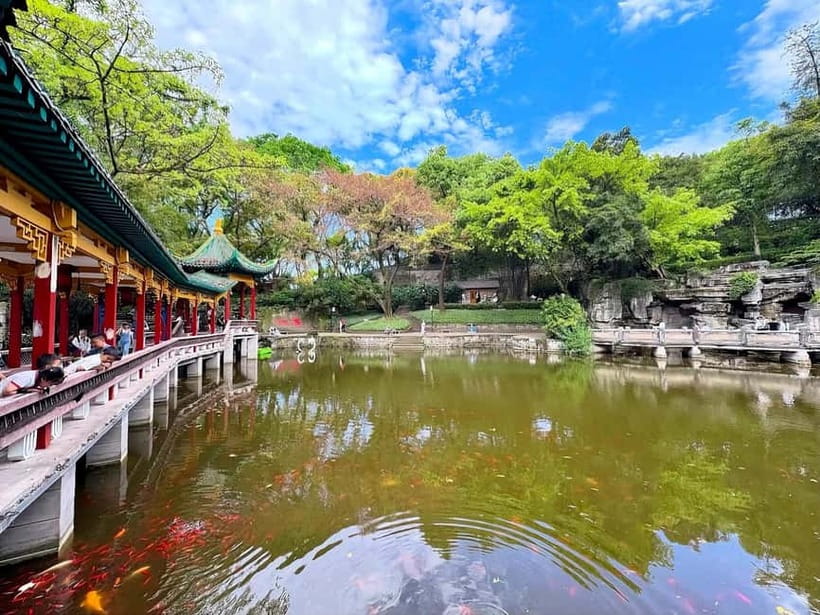
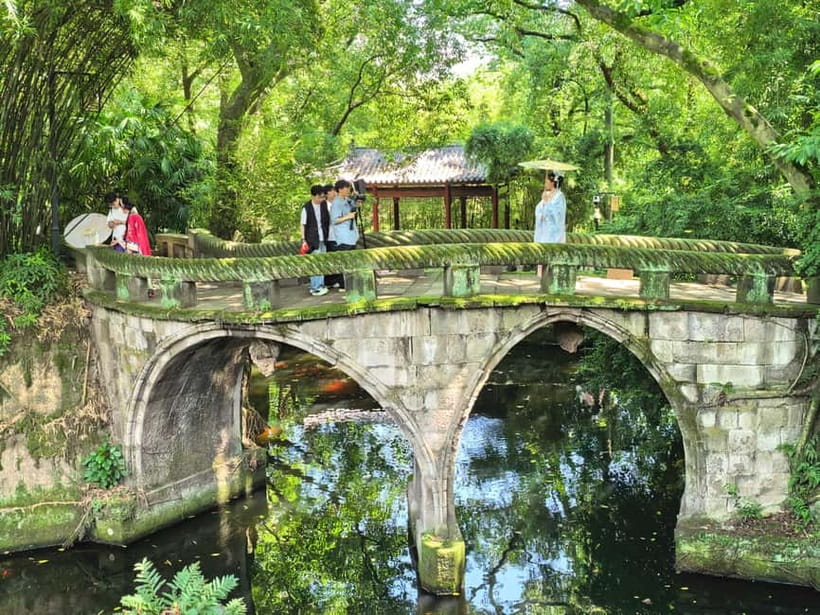
The morning starts in a large local Chinese garden. It is not treated as a quick photo stop. Your guide explains how rocks, ponds, pavilions, paths, and framed views are placed with purpose, then compares Eastern and Western garden design.
That conversation gives the garden more meaning. In a Chinese garden, you are not simply looking for one grand vista. You notice how a wall hides part of a pond, how a doorway frames a tree, or how a rock creates visual weight beside still water. The pleasure comes from moving through a series of carefully arranged views.
You get about an hour here, including walking and scenic stops. Wear shoes with a firm sole, since the day later adds hills and cliff paths. The tour description calls this garden one of Chongqing’s underrated places, and that fits the role it plays: it gives you a quiet start before the city’s trains, towers, roads, and crowds take over.
A few more spa visits around the world worth a look
- Budapest: Széchenyi Spa Day Ticket with Optional Upgrades
★ 4.3 · 23,911 reviews - Santorini: Volcanic Islands Cruise with Hot Springs Visit
★ 4.4 · 10,869 reviews - Krakow–Zakopane: Cable Car, Chocholow Baths, Cheese & Vodka
★ 5.0 · 10,720 reviews
Erchang’s factory halls and fresh tea
A 15-minute ride takes you to Erchang Culture and Creative Park, a reworked industrial area in old factory halls. The setting links Chongqing’s industrial past with independent design shops and contemporary art.
You can browse handcrafted jewelry and upcycled clothing, though shopping is not the sole reason to come. This is a useful stop for seeing how old industrial buildings can be given a new purpose without wiping away their original character. The visit lasts about 30 minutes, so think of it as a short walk and orientation rather than a long shopping session.
A cup of fresh tea is included for each person. Since food and other drinks are not included, this tea is a small but welcome part of the package. If you enjoy local drinks and design shops, Erchang adds variety to a day otherwise focused on parks, transport, views, and exercise.
A local neighborhood before lunch
The next stop is described as a secret local area with a vintage Chongqing feel. You walk through a residential district and get a look at an older side of the city, away from the polished image of skyscrapers and major attractions.
The food stop follows this neighborhood walk. You can taste local street food and snacks at a simple restaurant, with an optional authentic lunch or a less spicy hotpot available as an add-on. Food and drinks are otherwise your responsibility, so budget extra for this part of the day.
This is also the point where you should speak up about spice. Chongqing food is famous for bold flavors, but the tour specifically notes that less spicy choices can be arranged. The supplied details do not promise a particular menu, so do not assume every dish will be mild. Tell your guide early if you need food with less chili or gentler seasoning.
The one-hour lunch break gives you a chance to rest before the afternoon’s walking. It is practical rather than formal, and that suits the tour’s focus on ordinary local life.
Liziba Monorail Station, Chongqing’s great engineering joke
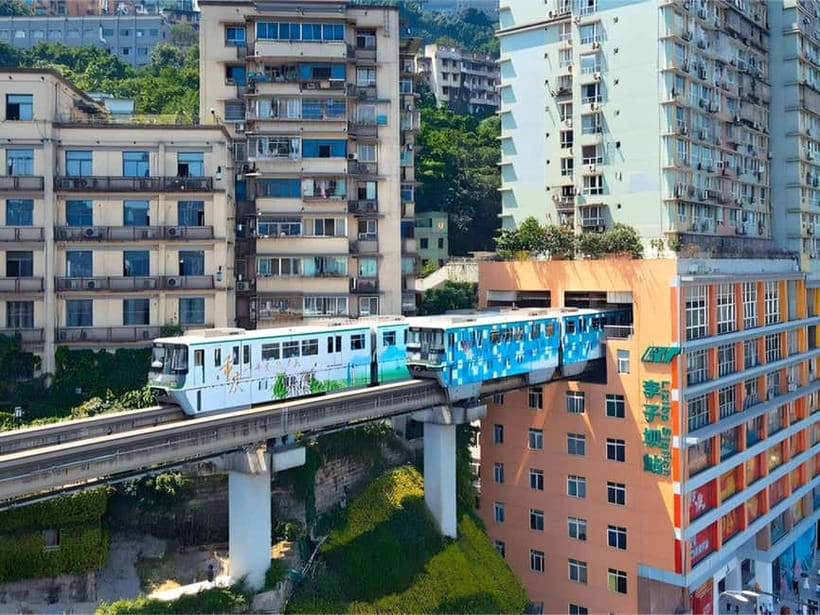
After lunch, you reach Liziba Viewing Platform. Here, the monorail runs directly through a residential building, passing through the middle floors of the apartment complex. The train is not a screen trick or a staged effect. It really enters the building, an answer to Chongqing’s shortage of flat ground and its need to fit transport into steep urban space.
The best viewing area is the small square across from the building. Trains pass about every four to six minutes, so you usually will not wait long for the key photograph. Your guide can help you understand what you are seeing and time your stop around the train’s arrival.
Allow about 30 minutes. That is enough for several train passes, photos, and a short explanation, but not enough for a long neighborhood visit. The spectacle is easy to understand, which makes it one of the day’s most accessible stops. Even if you have little interest in railways, the sight of a bright train appearing from an apartment block is hard to forget.
Same place, a different way to unwind:
- Bali: Mount Batur Sunrise Guided Hike and Natural Hot Spring
★ 4.8 · 9,284 reviews - Reykjavik: Sky Lagoon Entrance Pass With 7-Step Spa Ritual
★ 4.8 · 6,166 reviews - Prague: Bernard Beer Spa with Beer and Massage Option
★ 4.8 · 4,164 reviews - Krabi: Tiger Cave Temple, Emerald Pool and Hot Springs Tour
★ 4.8 · 3,616 reviews
Cliffside paths above Chongqing’s stacked streets
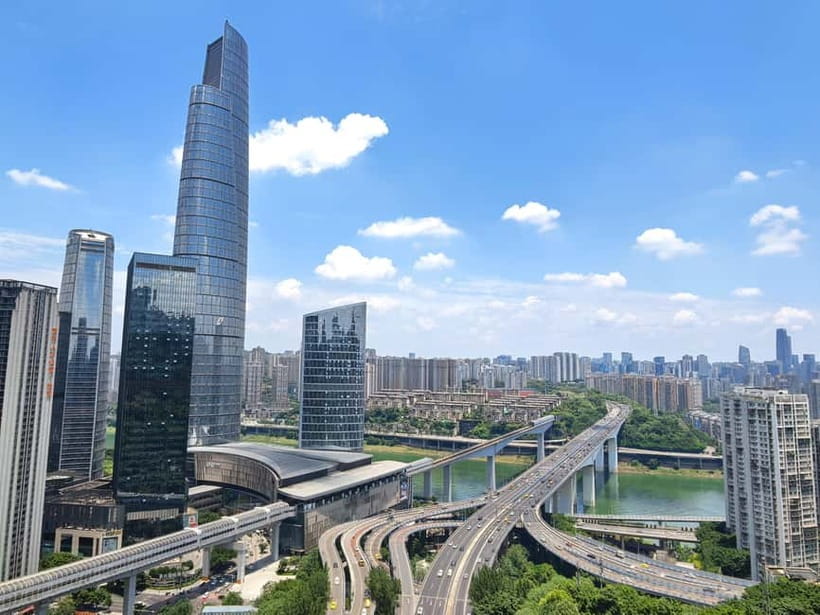
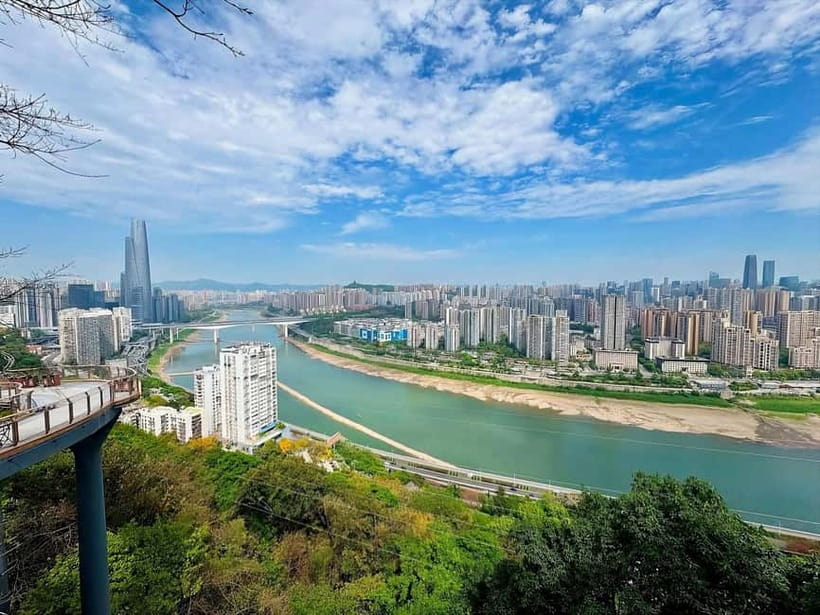
The afternoon shifts from transport engineering to mountain engineering. You follow a walkway built into a cliff and look across Chongqing’s steep urban form. Towers rise from narrow valleys, roads fold around hills, and buildings appear stacked in layers.
This is the stop for wide city photographs, but the view also explains Chongqing better than a flat street map can. The city’s unusual monorail routes, bridges, roads, and tall buildings all make more sense once you see how little level ground is available.
The tour includes a cliffside walk in a local park, with about 40 minutes listed for the later scenic stop. Expect walking and possible changes in elevation. The information does not give a precise stair count or trail surface, so anyone with knee, balance, or breathing concerns should ask the operator for current conditions before booking.
The views are a major reason to choose this experience, but you should not expect a relaxed viewpoint reached by car. Comfortable clothes, water, and good walking shoes are essential. Insect repellent is also recommended.
The old park, 3D city stories, and a train through spring
Another stop leads down narrow alleys to an old park where tourists rarely venture. Three-dimensional sculptures tell stories from Chongqing’s past as a port city built across hills.
That detail makes the stop more than a photo break. The sculptures give you a visual way to connect the city’s steep terrain with its working past. Your guide can fill in the context, which is especially useful if you do not read Chinese.
The route also includes the sight called Monorail to Spring. Here, a bright train glides past seasonal flowers and urban buildings, creating a pleasing contrast between machinery, plants, and concrete. In March and April, cherry blossoms may add color to the scene, but seasonal flowers are never guaranteed outside that period.
The wording of the schedule treats this as a short walk and scenic visit rather than a separate major attraction. Think of it as a rewarding side route for photographers and people who enjoy seeing how Chongqing residents use small pockets of space.
Baduanjin with Tai Chi master Tian
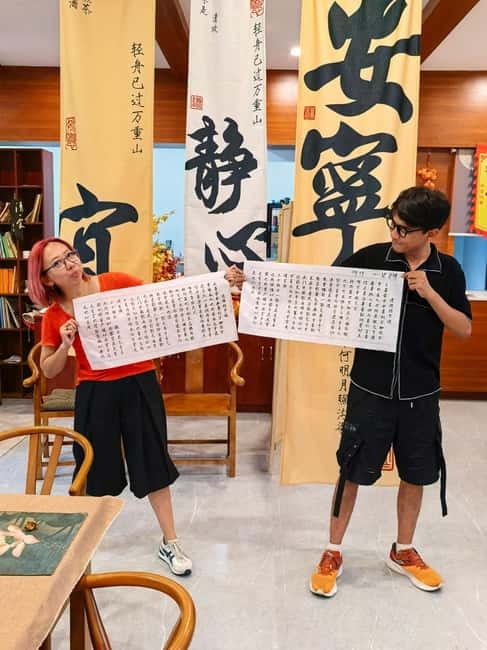
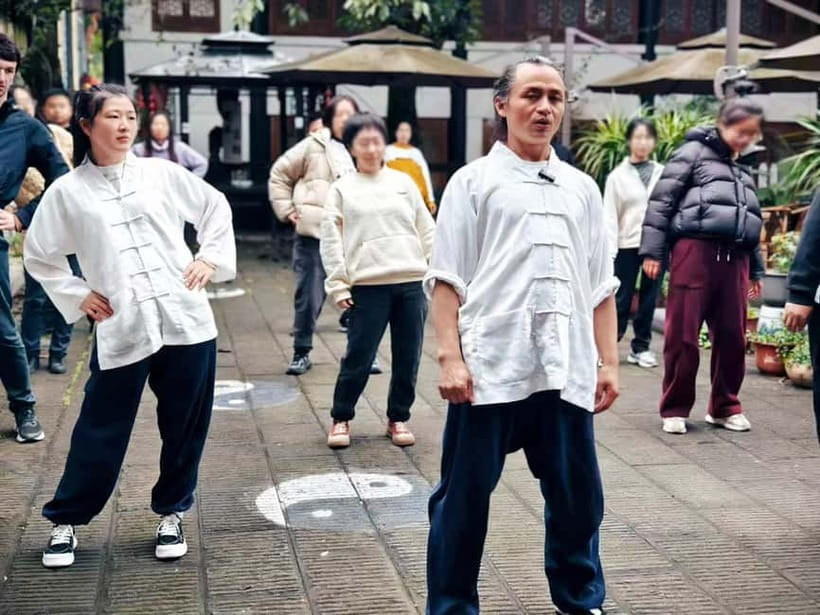
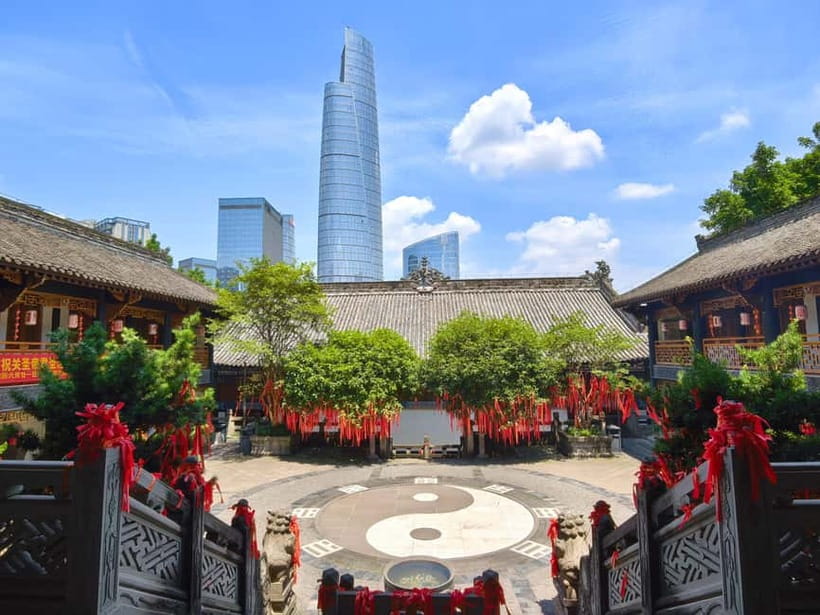
The final major activity takes place at a Taoist sanctuary in the city. Under the guidance of Tian, described as a national Tai Chi master and inheritor of intangible cultural heritage, you learn Baduanjin, an ancient exercise system known as the Eight Silken Movements.
The movements are designed to be gentle and controlled. The session is presented as suitable for beginners, and the tour information says even people in their 60s can learn the basics quickly. You do not need advanced fitness or Tai Chi experience, but you do need enough mobility to stand, move, and follow instructions.
The full class lasts about two hours. That is a generous amount of time compared with a token demonstration. You have room to learn the movements, repeat them, and settle into a slower rhythm after a busy day of transport and sightseeing.
I like this ending because it changes your pace. Chongqing can feel loud, vertical, and hurried. Baduanjin asks you to pay attention to breathing, balance, and smooth movement. You also receive a small present from the temple, along with the included cup of tea.
The activity is not medical treatment, and the supplied information does not promise any health result. It is best understood as a cultural lesson and light physical practice with a traditional Chinese setting.
How the transport and timing work
The tour includes a 15-minute bus or car transfer, about 35 minutes by subway or metro, and other movement between stops. Depending on the group and the day, transport may use public transit with Didi support or a chartered car.
That flexibility is useful in Chongqing. Public transport lets you experience the city as residents do, while a car can save energy between hills and timed stops. The precise choice may depend on traffic, group needs, and the operator’s arrangements.
Because the tour is private, you avoid being tied to a large group’s pace. You can ask questions, spend more time at a view, or flag a food concern. The tradeoff is that a full schedule may still feel busy, especially when walking and transfers are combined.
The tour offers free cancellation up to 24 hours before the start and a reserve-now, pay-later option. Starting times depend on availability, so check the actual date and pickup details before paying. Bring your passport, since it is specifically required.
Who will get the most from this day
You are a good match for this tour if you want more than a checklist of Chongqing’s famous sights. It suits curious first-time visitors, photographers, families with mobile older children, couples, and people interested in Chinese gardens, traditional exercise, local food, and city design.
It is particularly useful if you want a guide who can connect separate sights. The garden explains design, the factory park shows reuse of industrial space, the cliff path explains the city’s terrain, Liziba shows transport adaptation, and Baduanjin provides a cultural activity rather than another viewpoint.
You should think twice if you want a slow day, dislike public transport, or cannot manage hills and extended walking. The activity is not suitable for wheelchair users, people with mobility impairments, people with epilepsy, or anyone over 80 according to the stated restrictions. Party groups, bachelor and bachelorette groups, and smoking indoors are not allowed.
Bring water, comfortable shoes, and loose clothing. Do not bring weapons or sharp objects, alcohol, drugs, fireworks, or explosive materials. Bare feet, littering, and indoor smoking are also prohibited.
Is the $166 price fair?
At $166 per person, this is best judged as a private day with a guide, not as a collection of admission tickets. The included transport, multilingual service, tea, wellness session, temple gift, and planning are the main sources of value.
You are paying for access to a connected route that would take more effort to arrange alone. You would need to locate the garden, creative park, local neighborhood, Liziba viewing area, cliff walk, old park, and Taoist sanctuary, then manage transfers and timing. The tour also adds explanations and a hands-on Baduanjin class.
Food is not included, and optional lunch or hotpot costs extra. That keeps the base price clearer, but you should add a meal budget. If you are traveling alone, the private price may feel high. For a couple, family, or small private group, the cost can make more sense because the guide and transport support are shared.
Should you book the Chongqing Active Wellness, Monorail, and Hidden Gems Tour?
Book it if you want a full, varied day that shows Chongqing as a city of hills, trains, gardens, older neighborhoods, creative reuse, and traditional movement. Tian’s patient guidance, English ability, and friendly approach are useful strengths, especially during the Baduanjin class and local food stops.
Skip it if you prefer a short sightseeing route, need step-free access, or want every meal and entrance fee folded into one price. For active visitors who value local context over a simple list of landmarks, this tour offers a thoughtful way to see Chongqing from several angles.
FAQ
How long is the Chongqing Active Wellness, Monorail, and Hidden Gems Tour?
The tour lasts eight hours, beginning and ending in Chongqing’s Yuzhong District.
What languages are available?
Live guiding is available in English, Traditional Chinese, French, Italian, and Spanish. Tian is specifically noted as speaking English and Italian.
Is the tour private?
Yes. It is arranged for a private group rather than a shared large-group departure.
Is lunch included?
No. Food and drinks are not included in the base price. You can arrange an authentic simple lunch or a less spicy hotpot through available add-ons.
What transport is used?
The tour may use public transportation with Didi support or a chartered car. The schedule includes a 15-minute bus or car transfer and about 35 minutes by subway or metro.
What happens at Liziba Monorail Station?
You watch a monorail pass through the middle floors of a residential building from a viewing platform across the street. Trains usually pass every four to six minutes.
Is prior Tai Chi experience required?
No. The Baduanjin movements are presented as simple for beginners, and the two-hour session includes guidance from Tai Chi master Tian.
Is the tour suitable for wheelchair users or people with mobility impairments?
No. The tour involves walking, hills, and cliffside paths and is not suitable for wheelchair users or people with mobility impairments. It is also listed as unsuitable for people with epilepsy and people over 80.
Just added around the world
- Kootenay: From Icy Mountain Rivers to Steamy Hot Springs★ 4.6 · 8 reviews
- Ko Lanta: Private Tiger Cave, Hot Spring & Emerald Pool Tour★ 4.8 · 6 reviews
- Kobe Guided Tour Including Port Area and Arima Onsen Town★ 5.0 · 3 reviews
- Kobe: Arima Onsen Culinary Stroll & Food Tasting Tour★ 5.0 · 2 reviews
- Koh Samui: Sauna and Spa Relaxation Package★ 4.9 · 10 reviews
- Kemer: Turkish Bath Expereince with Hotel Transfers★ 3.8 · 25 reviews
- Kiruna: Overnight Snowmobile Tour with Dinner and Sauna★ 5.0 · 3 reviews
- Ko Lanta: Full Day Emerald Pool&Hot Spring With Tiger Temple★ 5.0 · 12 reviews
More spa days in China.
Shanghai:Authentic Chinese Body/Foot Massage, Hair& Head SPA
Read our review →
Shanghai Guided Royal Banquet Photo (Incl) with Massage Opt
Read our review →
Beijing : SHUIGUO luxury SPA & Recreation Club day ticket
Read our review →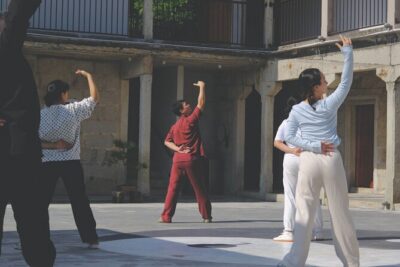
7-Day TaiChi & Qigong Wellness Retreat in China
Read our review →
Chengdu: Sichuan Opera Show & Covered Bowl Tea & Massage
Read our review →Other lists this one is on